
Beyond the Strategy Deck: What Clarity Actually Looks Like
Note: This post is part of a series about The Transformation Flywheel, in which we explore how to nurture the conditions that generate sustainable momentum for transformative change.
Six months after the strategy rollout, the CEO asks Sarah in Legal what the company's top priorities are. Sarah hesitates. "Well, we're focused on customer experience and operational excellence and... digital transformation?" The CEO nods politely and moves on, but on the inside, he's screaming.
Meanwhile, the product team is sprinting on twelve different "top priority" initiatives. The marketing team just launched a campaign that contradicts what sales is promising customers. And in the break room, people are openly wondering if leadership actually knows what they're doing.
This isn't a Sarah problem. It's a clarity problem.
And before you think, "Yeah, but our strategy is clear…" — let me stop you. Your strategy deck probably looks beautiful. The executive team approved it. You spent months wordsmithing the vision statement and mapping every initiative to an owner. But if Sarah in Legal can't explain your priorities, and if twelve things are simultaneously top priority, then you don't have clarity. You have the illusion of clarity, which is actually worse than having no strategy at all.
The expensive difference between pretty clear and really clear
What happens when strategy isn't actually clear? Teams waste time in meetings debating decisions that should be obvious. Resources get spread across too many initiatives. People burn out trying to do everything at once. Trust in leadership erodes because employees can't see the through-line between what leadership says matters and what their manager is asking them to do today.
The numbers back this up. Research shows that lack of strategic clarity accounts for about a third of the difference between high and low-performing organizations in terms of revenue growth, profitability, and employee engagement. A third. That's not a rounding error.
The problem isn't that leaders don't care about clarity. It's that they don't understand the difference between a strategy that looks clear on PowerPoint and one that actually drives aligned action across the organization.
Your typical strategy deck checks all the boxes. Vision statement? Check. Mission? Check. List of initiatives with owners? Check. But it fails the Sarah test. It fails the "can a smart person three levels down make a decision that aligns with our priorities without asking permission" test. It fails the "would everyone in this room choose the same thing if forced to pick between two good options" test.
Real clarity doesn't just explain where you're going. It creates the conditions for thousands of daily decisions to align without constant supervision. That's the difference between pretty clear and really clear.
What actually drives clarity
Real strategic clarity does three specific things. First, it brings focus—it tells you what to concentrate on and, just as importantly, what to ignore. Second, it generates alignment so that even when people are working on different projects, they're pulling in the same direction. Third, it fosters autonomy by giving people enough context to make good decisions on their own.
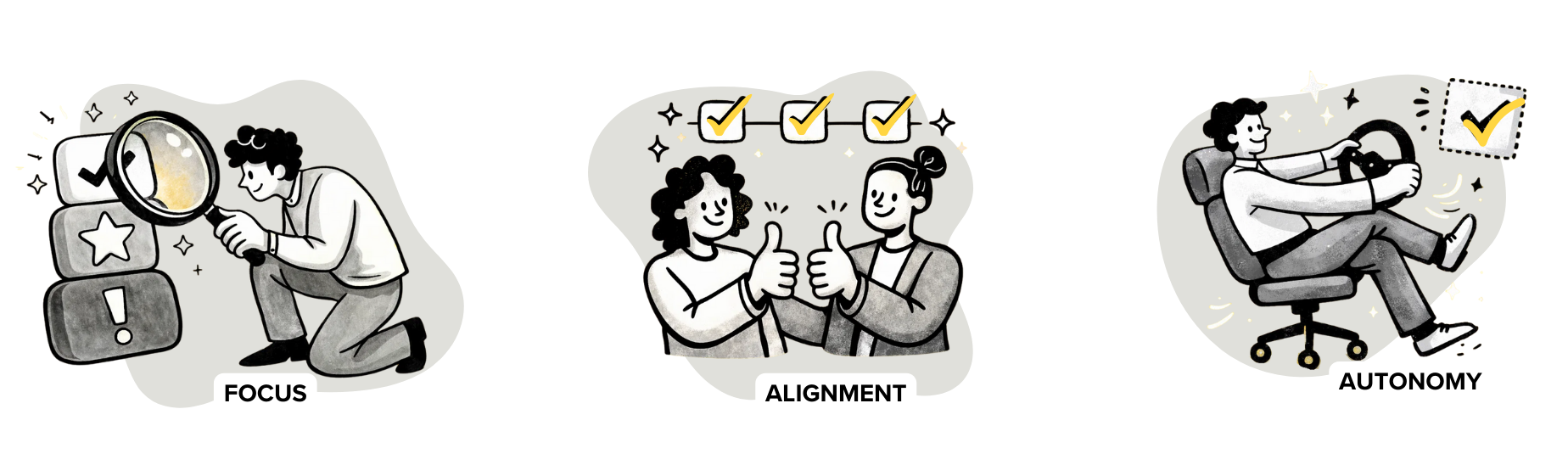
Most strategy decks fail at all three.
They fail at focus because they're inclusive to a fault. Every stakeholder gets their initiative on the list. Nothing gets cut because cutting something might offend someone. So you end up with a "strategy" that's really just an inventory of everything the company is doing.
They fail at alignment because the language is too abstract. "Operational excellence" means something different to every person who reads it. Without concrete definitions and examples, everyone interprets the strategy through their own lens.
And they fail at autonomy because there's no decision-making framework. When someone faces a choice between two good options, they have to guess what leadership wants instead of applying clear principles.
This is fixable. But it requires doing five things that most organizations skip because they seem too simple or too time-consuming.
The five things that actually matter
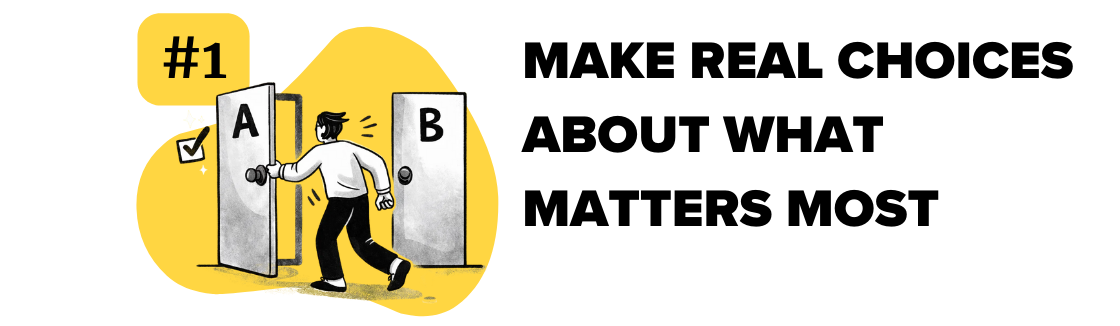
Steve Jobs said it best: "People think focus means saying yes to the thing you've got to focus on. But that's not what it means at all. It means saying no to the hundred other good ideas that there are."
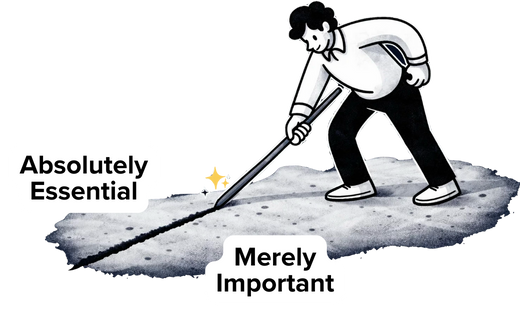
Your strategy can't be a list of everything you're doing. That's not strategy, that's inventory. Real strategy requires choosing which things to go big on and which things to go small on. It means being explicit about what's critical ground to take versus what's necessary just to keep the lights on.
When we help clients rationalize their agenda, one of the most impactful things we do is force this distinction. We make them draw a line between ‘critical to transformation’ and ‘required to run the business.’ Both matter, but they're not the same thing, and they shouldn't get the same level of attention and resources.
This is where most organizations chicken out. They don't want to tell anyone their project isn't critical. So everything becomes critical, which means nothing is actually critical.
Your people already know when you're pretending everything is equally important. They see the resource constraints. They feel the competing priorities. When you pretend there's no trade-off, you're not protecting morale—you're destroying trust.
Not "be the market leader in innovative solutions." That's corporate gibberish. You need something concrete enough that someone could draw it. Something measurable enough that in twelve months, everyone will agree on whether you achieved it or not.
Here's the thing about vision that's so obvious we miss it: a vision has to be visible. Our brains don't process abstractions well. They demand pictures. Say "red apple" and you see it instantly—the glossy skin, the weight in your palm, maybe even the crisp sound of that first bite. That's not poetic language, that's neuroscience. We're wired for images, from cave paintings to corporate logos.
Yet executives continue to brandish vision statements like ceremonial swords—impressive to display, but completely useless in battle.
Think about Microsoft's old vision: "a computer on every desk and in every home." You can see that. Empty desks waiting for computers. Homes about to change forever. Now compare that to the generic corporate speak most companies produce: "pioneering sustainable solutions for tomorrow's challenges." What does that look like? What would change if you achieved it? You have no idea, and neither does anyone on your team.
If people can't see it, they can't remember it. And if they can't remember it, they definitely can't align their daily work with it.
Think about Kennedy's moon shot: "Before this decade is out, land a man on the moon and return him safely to Earth." That's a real goal. It has a timeframe. It has a clear outcome. Anyone working on the Apollo program could evaluate whether their work was contributing to that goal. More importantly, they could picture what success looked like—a human being standing on the lunar surface, planting a flag, then coming home.
Now think about your strategy. Could someone three levels down look at their work and definitively say whether it's advancing your main objective? Could they sketch what success looks like? If not, your picture isn't vivid enough.
When we work with clients on strategic narrative, we push them to articulate clear statements of intent with specific timeframes and tangible outcomes. Then we bring those to life with what we call "postcards from the future"—vignettes depicting what success actually looks like for customers, for employees, for the business.

Not metaphorical. Literal. This is what the customer experience looks like when you open the app and how you will help them achieve their goal. This is what your operational dashboard shows when you've solved the capacity problem. This is what a typical Tuesday feels like for your frontline employees when the transformation has taken hold.
This isn't about making pretty pictures for executives to admire. It's about creating shared understanding that survives the translation from boardroom to breakroom. Words get reinterpreted. Images stick. When fifty people can point to the same picture and say "that's what we're building," you've created the foundation for aligned action.
Meaningful goals motivate action. Visual communication makes complex information stick. Together, they give people something concrete to work toward instead of a vague aspiration to "disrupt" or "innovate." They transform "what if" into "what's next."
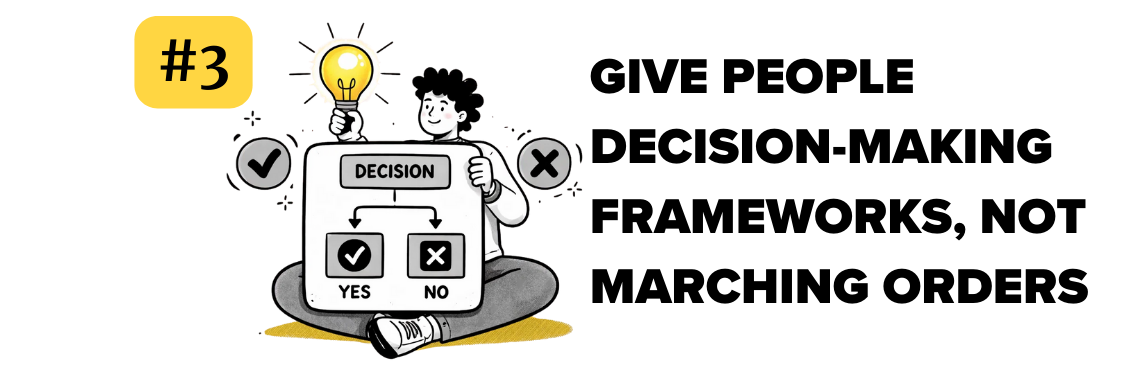
Clarity collapses under scale.
When you're ten people in a room, everyone knows what matters. Intent is obvious. Taste is shared. But as organizations grow, that clarity fragments. What makes a difference becomes subject to interpretation. Your product loses its character. Your competitive edge dulls. The vision that seemed so clear at fifty people becomes incoherent at five hundred.
This isn't because people stop caring or because leadership loses its way. It's because vision doesn't scale on its own. Taste doesn't scale on its own. They scale only when they're encoded into how work happens and how decisions are made.
That's where most organizations fail. They articulate the vision, communicate the strategy, and then assume people will just figure out how to apply it to their daily decisions. But without explicit frameworks for decision-making, every choice becomes an interpretation exercise. And interpretation varies wildly based on who's doing it, what function they're in, and what pressures they're facing.
The best strategies clarify intent and define boundaries while leaving execution to the people closest to the work. This is where the military concept of "commander's intent" becomes useful in business.
Commander's intent means you explain the why and the what, but you don't micromanage the how. You give people enough context to make good decisions without constantly asking permission. But you also give them guardrails so they're not making it up as they go.
We use two techniques that work exceptionally well for this. First, "even/over statements"—explicit strategic preferences between two good alternatives. "Mobile experience even over desktop experience." "User growth even over revenue." These make hard choices explicit and reduce the cognitive load when someone faces a dilemma.
Second, steering metrics—a carefully curated set of leading indicators that predict whether you're going to succeed before you actually succeed or fail. Not fifty lagging KPIs that tell you what already happened. Five or six forward-looking measures that actually matter. Things like customer engagement trends, not just revenue. Pipeline velocity, not just closed deals. Employee activation in the transformation, not just headcount.
The difference matters enormously. Lagging indicators tell you the score after the game is over. Leading indicators tell you whether you're executing the plays that win games. They create the feedback loop that lets you adjust in real time, not six months after you've already missed the target.
Together, these tools help teams navigate the real-world dilemmas they encounter without playing "guess what the boss wants" every single day.
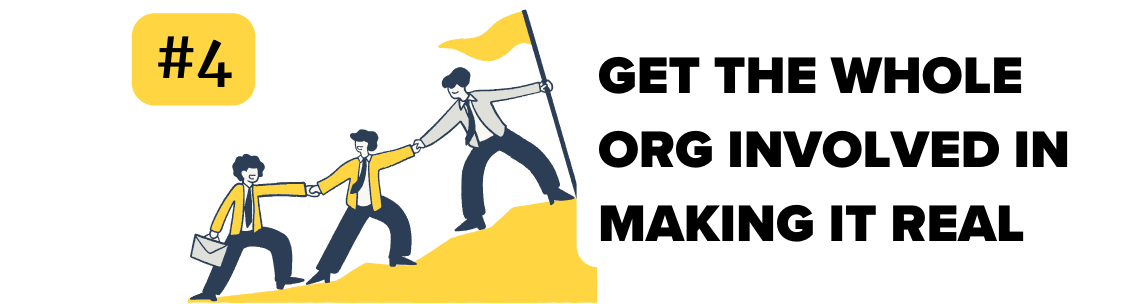
Strategy doesn't take root through a single all-hands presentation. It takes root through repeated conversation, tailored to different contexts, facilitated by line managers who can answer the question: "What does this mean for our team?"
This is where most transformation efforts collapse. Leadership rolls out the strategy once, maybe twice, and then wonders why nothing changes. But strategy isn't a presentation—it's an ongoing conversation.
The research backs up what we've seen with clients: at least seven percent of employees need to be formally involved in transformation initiatives for the effort to generate positive returns. In most organizations, only two percent are involved. That gap matters enormously.
When we work with clients, we push them to involve people in two specific ways. First, elevate a core group as initiative owners—high performers, new joiners, front-line employees who are closest to customers. Give them real responsibility for designing and implementing change. Second, empower a broader group of influencers and managers to amplify behaviors and model the changes you're trying to make.
This isn't feel-good participation theater. This is how strategy moves from PowerPoint to reality. The people doing the work know things leadership doesn't. They see obstacles leadership can't see. They have ideas leadership hasn't thought of. When you involve them early, you get better solutions and you build the buy-in you need for execution.
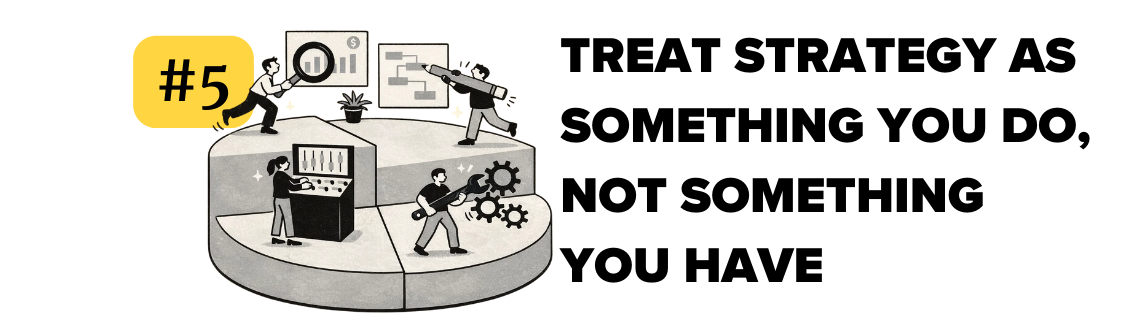
Here's the part where some complexity is necessary: strategy can't be static. Markets shift. Competitors move. What looked like the right call six months ago might need adjustment based on what you've learned.
This doesn't mean your strategy should change every quarter. It means you need ongoing mechanisms to monitor progress, capture learnings, and make course corrections. Your steering metrics—those few leading indicators that actually predict success—should be part of regular governance rituals. Your leadership team should be having recurring conversations about what's working and what's not.

The goal isn't a perfect plan that never changes. The goal is shared understanding that evolves as circumstances change. Which is why that ongoing communication and dialogue we talked about earlier isn't optional—it's how you maintain alignment in a dynamic environment.
Move away from thinking about strategy as a document you update every few years. Think of it as an ongoing process of orchestrating alignment and execution as circumstances change.
Making this real
We recently worked with a global communications agency whose transformation was stuck. They had the beautiful PowerPoint deck. They had the executive buy-in. But six months in, nothing was really moving.
We helped them get really clear. We articulated their strategic intent in language that was concrete and measurable, then visualized it through storyboards of future customer journeys. We translated it into a cascade of information that built shared understanding across the organization. We rebooted their transformation roadmap with clear priorities and crisper guidance. We defined steering metrics—five leading indicators that enabled ongoing focus on what mattered most.
The results: a 43% increase in employees reporting they understood the purpose of the transformation, and a 57% increase in them seeing implications for their role. Not because we made their strategy more complex. Because we made it clearer.
Here's your move: take your strategy deck and run it through the Sarah test. Can someone three levels down explain your top priorities? Can they decide between two good options without asking permission? Could they sketch what success really looks like? If not, you don't have a clarity problem to fix someday. You have a clarity problem that's costing you money and momentum right now.
Stop wordsmithing vision statements. Start creating the conditions for aligned action. That's what real strategic clarity looks like.
At Beacon we regularly help clients articulate and activate strategy, cultivating greater clarity and buy-in about what’s worth doing and how to get there. If you feel your organization or team is lacking sufficient clarity or struggling to close the gap between intention and impact, we’d love to hear from you.